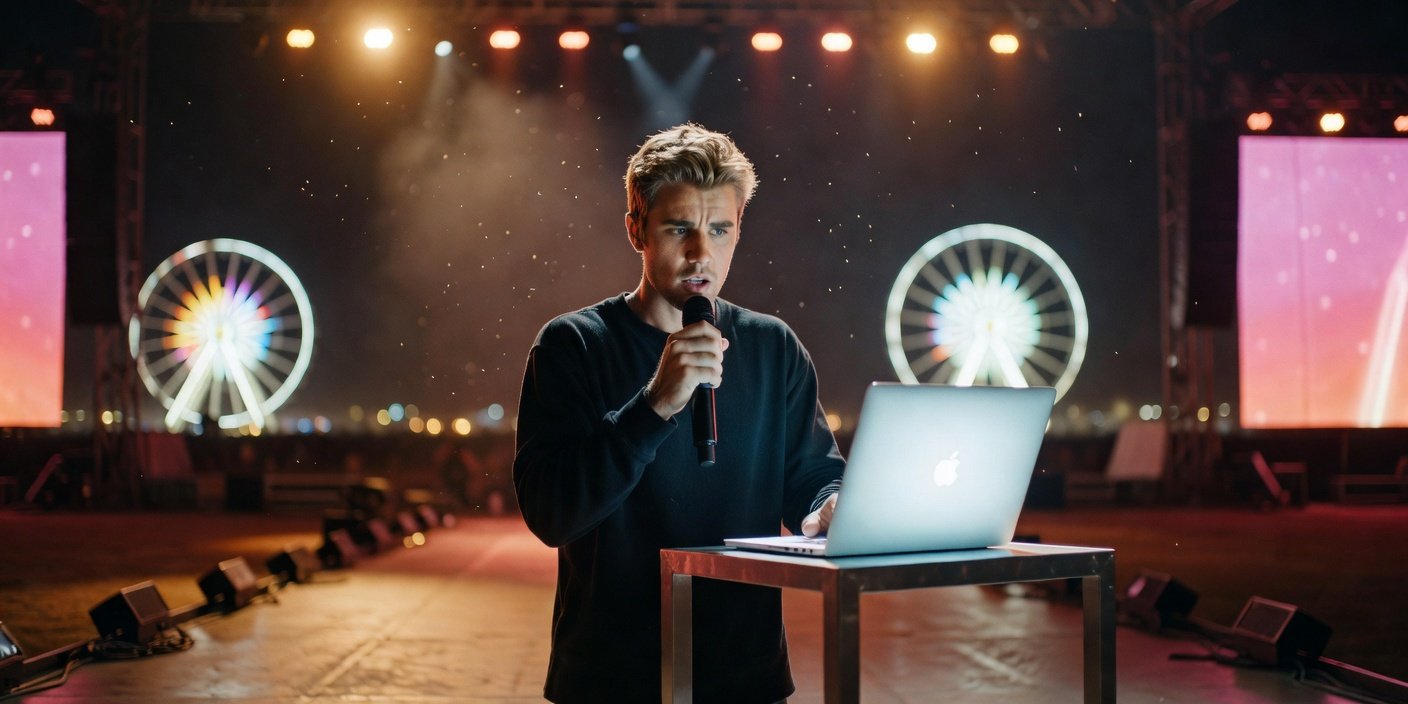
Coachella 2026’s second day proved the festival is in a state of radical flux, shifting from the traditional ‘grand spectacle’ model toward a more meta, technology-embracing, and often ironic performance culture. The headlining grabber, Justin Bieber, famously eschewed standard pyrotechnics for a ‘YouTube karaoke’ session, while industrial music legend Trent Reznor teamed up with German producer Boys Noize to prove that the Sahara stage—typically the domain of pristine EDM—can hold a darker, grittier industrial energy. Combined with Jack White’s grounding, guitar-heavy set, Day 2 offered a masterclass in the tension between digital convenience and analog intensity.
Key Highlights
- The Bieber Paradox: Justin Bieber’s headlining set focused on a 34-song run that felt more like a late-night streaming session than a polished stadium show, with the star interacting with live YouTube comments on a stage-bound laptop.
- Nine Inch Noize: The highly anticipated collaboration between Nine Inch Nails and Boys Noize transformed the Sahara stage into a ‘ghoulish rave,’ successfully blending industrial aggression with modern rave rhythms.
- Jack White’s Anchor: Amid the digital experimentation, Jack White provided a visceral, guitar-centric performance at the Mojave stage that served as a necessary reminder of live instrumentation’s raw power.
- Festival Climate: Beyond the music, attendees navigated a second day marked by extreme desert winds and ongoing debates regarding the future of festival ticket pricing and scalping legislation.
The Shift to Digital Intimacy and Industrial Chaos
The ethos of the modern music festival is changing, and Day 2 of Coachella 2026 served as the definitive proof point. As artists grapple with how to present themselves in a world dominated by social media feeds and streaming algorithms, the approach to the ‘Headliner Set’ is fracturing. Nowhere was this more apparent than in the polarizing reception of Justin Bieber’s late-night performance.
The Bieber Paradox: A New Era of Headlining
Justin Bieber’s appearance was billed as the pinnacle of the Saturday schedule, but he defied expectations by delivering what many critics are calling the ‘anti-spectacle.’ Instead of a meticulously choreographed army of dancers, Bieber arrived with a single laptop, a microphone, and an attitude that felt remarkably close to his bedroom-pop roots.
By engaging with the YouTube livestream comments in real-time, Bieber collapsed the distance between the performer and the audience. This wasn’t just a concert; it was an exercise in ‘meta-performance.’ The setlist, spanning 34 songs, included deep cuts and spontaneous requests, challenging the audience to lean into the chaos of a live digital environment. While purists may have missed the traditional polish of a main-stage headliner, the strategy signaled a broader shift in the pop industry: authenticity, even when messy or glitchy, is becoming the new premium currency.
Nine Inch Noize: Rebranding the Sahara Stage
The Sahara stage has long been the fortress of EDM, K-pop, and high-energy electronic beats. However, the debut of ‘Nine Inch Noize’—a collaborative project between industrial titan Trent Reznor and German electro-producer Boys Noize—shattered that uniformity.
The set was a sonic collision. Reznor’s trademark detuned clangs and pessimistic lyrical delivery found a symbiotic home in the bone-snapping breakdowns and high-BPM precision of Boys Noize. The result was a ‘ghoulish rave’ that felt dangerous, unpredictable, and entirely out of place—which is precisely why it worked. By bringing industrial rock into a space typically reserved for sunshine-drenched electronic music, the duo challenged the festival to expand its definitions of what a ‘party’ at Coachella actually entails.
Jack White and the Analog Counterbalance
If Bieber represented the future of digital-first performance, Jack White represented the enduring, stubborn heart of rock and roll. Playing the Mojave stage, White’s set was a stark contrast to the screen-lit, tech-heavy atmosphere elsewhere on the grounds.
White’s reliance on raw amplification and improvisational guitar work acted as the perfect counterbalance to the digital noise of the day. In an era where audiences are increasingly tethered to screens, White’s performance was a reminder of the visceral, physical connection between a musician and an instrument. For fans who were feeling overwhelmed by the digital experimentation of the main stage, White provided the anchor—a reminder that music, at its core, is still about vibration and energy.
Secondary Angles: Contextualizing the 2026 Landscape
To understand the broader implications of Coachella 2026, one must look past the stage and into the industry machinery that underpins the festival.
The Economics of the Festival Experience
The 2026 festival season is operating against a backdrop of increasing economic friction. As ticket prices soar past the $4,000 mark in some resale markets, California legislators are under pressure to curb scalping practices. Day 2’s atmosphere was underscored by this tension; attendees were acutely aware of the ‘cost-per-hour’ of their experience. This financial pressure is likely driving artists to deliver more ‘unique’ moments—like the Bieber karaoke session—to justify the high price of admission. The event is becoming less about the music and more about the ‘exclusive content’ that only those in the desert can witness.
The Evolution of the Sahara Stage
Historically, the Sahara stage was designed for the ‘drop.’ In 2026, we are seeing a shift toward ‘textural’ electronic music. The success of Nine Inch Noize suggests that audiences are bored with the predictable builds and drops of standard EDM. The festival is effectively testing whether ‘industrial rave’ can sustain the same engagement numbers as mainstream house music. If the crowd density at the Nine Inch Noize set is any indication, the future of the Sahara is looking darker, heavier, and more experimental.
The Impact of Environmental Volatility
It is impossible to ignore the environmental factors plaguing the 2026 season. Violent winds disrupted the campgrounds on Friday, forcing a reconfiguration of festival operations. This unpredictability creates a shared sense of resilience among the attendees. The ‘ghoulish’ atmosphere of the Saturday night sets, particularly the industrial aesthetic of Reznor’s performance, felt entirely appropriate for a crowd that had just survived a wind-battered Friday. The environment, as much as the music, is dictating the aesthetic of the festival this year.
FAQ: People Also Ask
What is ‘Nine Inch Noize’?
Nine Inch Noize is a temporary collaborative project between the American industrial rock band Nine Inch Nails (led by Trent Reznor) and the German electronic music producer Boys Noize. The project blends Reznor’s signature aggressive, distorted industrial sound with the high-energy, rhythmic complexity of modern rave and electro music.
Why did Justin Bieber use a laptop on stage at Coachella?
Bieber’s use of a laptop was a deliberate artistic choice to create a ‘meta-performance.’ By interacting with real-time YouTube livestream comments and treating the set more like a live-streamed hangout than a traditional concert, he aimed to break down the barrier between the performer and the audience, embracing the chaotic nature of digital connectivity.
Will there be an official recording of these Coachella sets?
While Coachella typically broadcasts select performances via their YouTube livestream, the ephemeral nature of these sets—especially Bieber’s interactive karaoke session and the Nine Inch Noize collaboration—means that the full experience is often best preserved through fan recordings and the specific, temporary ‘moment’ created in the desert.