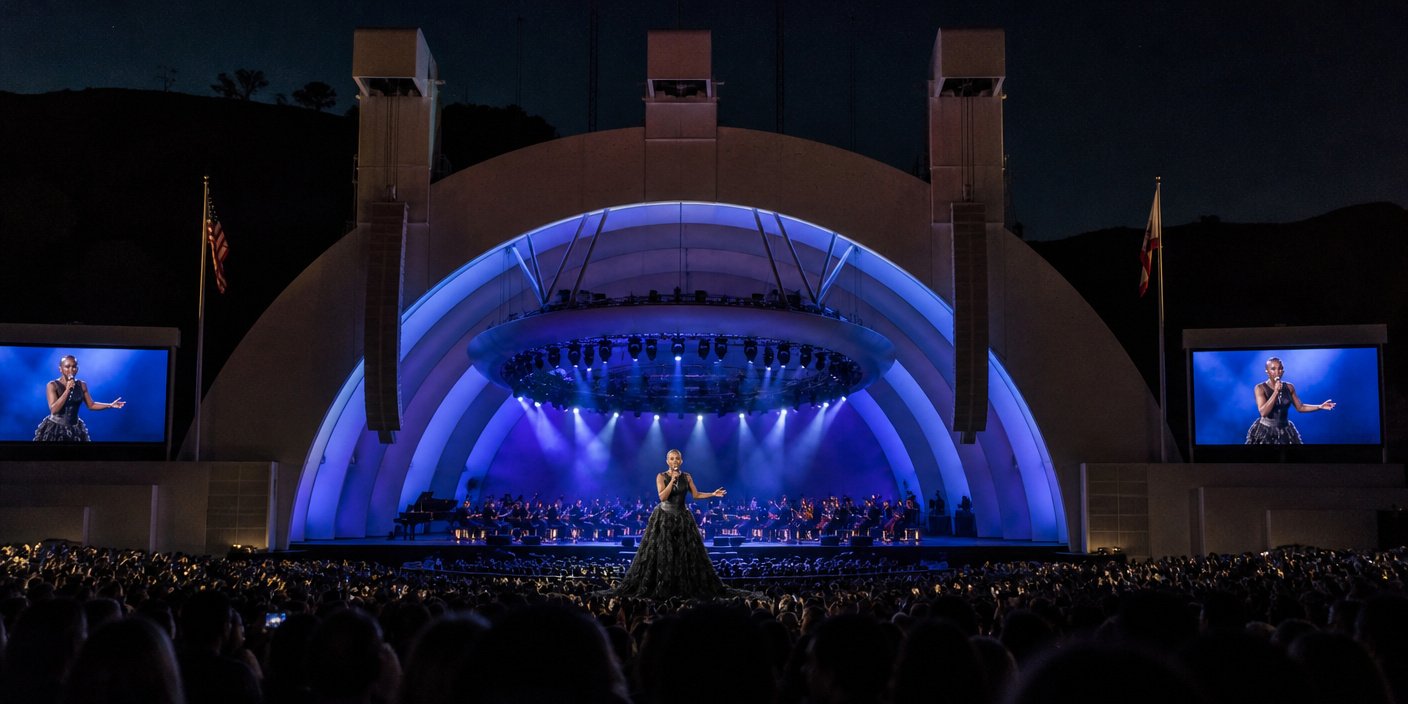
On the evening of October 15, the historic Hollywood Bowl bore witness not just to a concert, but to a masterclass in professional tenacity. Award-winning entertainer Cynthia Erivo, known for her soaring vocals and commanding stage presence, took to the iconic stage amidst a backdrop of personal health challenges that had threatened the very possibility of the performance. Just four days prior to the event, Erivo revealed that she was battling a severe chest infection, a condition that left her entirely without a voice—an existential crisis for any vocalist, let alone one tasked with headlining one of the most prestigious venues in the world.
Key Highlights
- The Vocal Crisis: Cynthia Erivo confirmed she had lost her voice entirely only four days before the scheduled October 15 performance due to a severe chest infection.
- Professional Resilience: Despite the medical advice and physical limitations, Erivo successfully executed a sold-out headline show at the Hollywood Bowl.
- Artistic Integrity: The performance served as a testament to Erivo’s technical mastery, as she successfully adapted her vocal delivery to accommodate her recovery state.
- Audience Connection: Erivo’s transparency regarding her health deepened her connection with the audience, framing the night as a triumph over adversity rather than a standard concert.
The Anatomy of a Vocal Recovery
The narrative of Erivo’s Hollywood Bowl performance is one of extreme physiological discipline. Vocalists operate at the intersection of athleticism and artistry; the vocal cords are delicate muscles that require optimal health to produce the resonance and pitch accuracy for which Erivo is globally celebrated. A chest infection does not merely affect the ability to produce sound; it impacts breath support, stamina, and the control required for nuanced vocal runs. When Erivo disclosed that she was ‘voiceless’ four days before the concert, she was essentially navigating the most acute phase of inflammation. The recovery process between that revelation and the opening curtain at the Hollywood Bowl suggests an intensive regimen of vocal rest, hydration, and medical supervision.
From a technical perspective, singing through a recent infection requires an expert understanding of ‘placement.’ When the primary vocal apparatus is compromised by inflammation, singers often pivot to techniques that prioritize forward placement and diaphragmatic support to alleviate strain on the cords. Erivo’s ability to execute her setlist suggests that she did not attempt to brute-force her way through the music, but rather navigated the sonic landscape with surgical precision. This is a crucial distinction: the difference between a performer who sings with reckless abandon and one who manages their instrument under duress. Her performance on October 15 was an exercise in restraint—not in terms of passion, but in terms of caloric and vocal expenditure—allowing her to hit the necessary emotional beats without risking long-term damage to her career.
The Hollywood Bowl: A Venue of High Stakes
It is impossible to separate the magnitude of this feat from the location. The Hollywood Bowl is not merely a venue; it is an acoustic landmark that demands absolute presence from its performers. The open-air setting requires a singer to project sound into a vast, uncontained space, a feat that is exponentially more difficult when the lungs are compromised by post-infectious residual fatigue. Historically, the Bowl has been a proving ground for the world’s most elite performers, from Judy Garland to The Beatles. For an artist to step onto that stage while knowing their instrument is not at 100% capacity requires a unique psychological fortitude. Erivo’s choice to proceed highlights a shift in how modern performers engage with their audiences regarding their health; rather than cancelling and disappointing thousands, she opted for radical transparency and a commitment to delivery, which fundamentally changed the audience’s reception. The crowd was not just watching a concert; they were participating in an act of endurance.
Transparency as the New Standard
Erivo’s decision to share her health struggles before the show reflects a broader cultural shift in the entertainment industry: the move toward ‘vulnerable professionalism.’ In previous decades, the ‘show must go on’ mentality often required performers to hide physical ailments behind a veneer of perfectionism. By opting to share the reality of her chest infection on social media, Erivo dismantled the expectation of superhuman performance. This transparency served several strategic purposes. First, it managed audience expectations, ensuring that any slight variations in vocal texture were understood contextually. Second, it humanized the star. Fans today crave authenticity; they connect with the struggle as much as the success. This narrative of overcoming a ‘silent’ week to perform a ‘magical’ night resonates deeply with audiences who are increasingly skeptical of pre-recorded lip-syncing and artificial stage personas. Erivo’s performance was undeniably live, undeniably human, and in its imperfections, arguably more compelling than a studio-perfect recording.
Secondary Angles: The Future of Vocal Performance
Looking beyond the singular event of October 15, this incident sparks a larger conversation about the sustainability of global touring. We are seeing more artists like Erivo speak openly about burnout, vocal strain, and the physical toll of live performance. As the industry evolves, we may see more ‘protected’ schedules where vocal rest is built into tour legs as a standard practice, rather than an emergency response. Additionally, the role of medical technology and specialized vocal coaches is becoming more critical to the infrastructure of touring. Erivo’s successful recovery and performance underscore the necessity for elite-level medical support teams that can rehabilitate a voice in a matter of days. Finally, this event highlights the power of the ‘story’ in music journalism—the performance was successful on its own merits, but the narrative of the ‘recovery’ amplified its cultural impact, proving that in the modern music economy, the context of the performance is just as important as the performance itself.
FAQ: People Also Ask
Q: Did Cynthia Erivo cancel her show at the Hollywood Bowl?
A: No. Despite losing her voice four days prior due to a severe chest infection, Cynthia Erivo chose to proceed with the show, delivering a critically acclaimed and emotionally resonant performance on October 15.
Q: How did a chest infection impact her vocal performance?
A: A chest infection typically causes inflammation in the airways, which can restrict lung capacity and vocal cord vibration. Erivo had to rely on advanced vocal techniques, specifically focusing on breath support and controlled placement, to ensure she could sing without causing long-term damage to her voice.
Q: Why is it significant that she performed at the Hollywood Bowl specifically?
A: The Hollywood Bowl is an iconic, large-scale, open-air venue that requires significant vocal projection. Performing there is a high-stakes endeavor for any singer, as the acoustics demand absolute precision, making it an incredibly challenging environment for a performer recovering from a respiratory illness.
Q: How does this change the way we view celebrity health?
A: Erivo’s transparency marks a shift toward ‘vulnerable professionalism.’ By openly discussing her health crisis before the show, she fostered a deeper connection with her audience, proving that vulnerability and artistic integrity are not mutually exclusive.