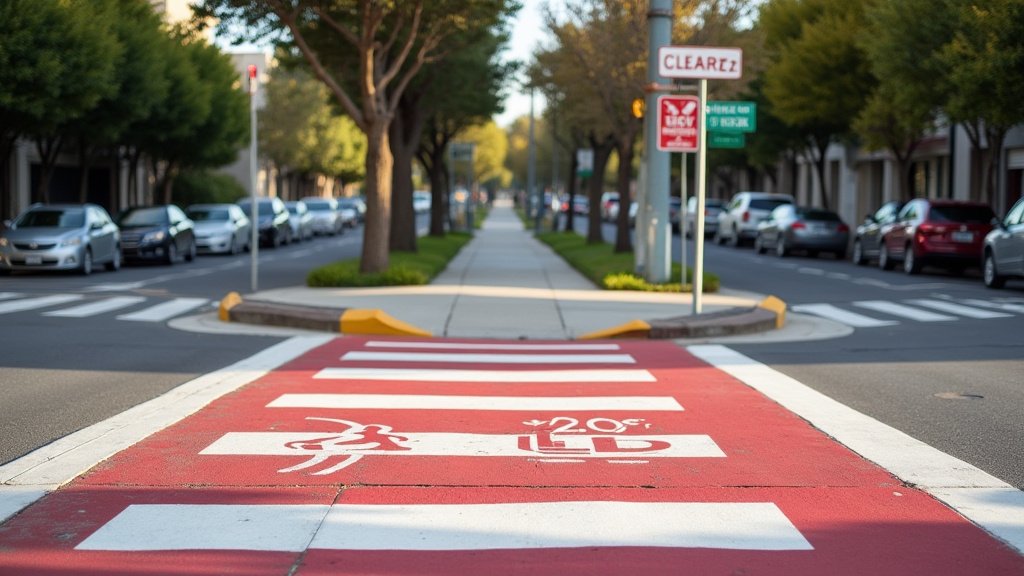
California’s approach to pedestrian safety is undergoing a structural overhaul as the state prepares to enforce Assembly Bill 413 (AB 413), a legislative mandate that fundamentally changes how drivers interact with intersections. Effective July 27, 2026, this ‘Daylighting to Save Lives’ law establishes a statewide prohibition on stopping, standing, or parking a vehicle within 20 feet of the approach side of any marked or unmarked crosswalk. By clearing these zones, the state aims to eliminate visual obstructions that have historically contributed to pedestrian-vehicle collisions. This shift moves California away from a patchwork of local ordinances toward a unified, high-visibility safety standard designed to align with Vision Zero objectives.
The Science of ‘Daylighting’ and Intersection Visibility
At its core, daylighting is an urban design strategy that increases the visibility of pedestrians at intersections. By removing parked vehicles, delivery trucks, or other obstructions near the curb, daylighting expands the sightlines for both drivers and those entering the crosswalk. Engineering studies have consistently shown that when drivers are prevented from pulling up directly to the corner of an intersection, their ability to perceive pedestrians—particularly children, individuals using mobility devices, or those with slower crossing speeds—is significantly improved.
When a large vehicle, such as a delivery van or SUV, is parked immediately adjacent to a crosswalk, it creates a ‘blind spot’ for oncoming drivers. The pedestrian becomes invisible until they are already in the traffic lane. By creating a 20-foot buffer, AB 413 provides the necessary ‘reaction window’ for drivers to yield appropriately. This legislative change acknowledges that road safety is not solely a matter of behavioral enforcement or speed control, but is fundamentally linked to the physical design of the built environment.
Navigating the Legislative Path: AB 413
Assembly Bill 413, authored by Assemblymember Alex Lee (D-San Jose), navigated the California legislature with a clear focus on the state’s rising pedestrian fatality rates. Despite initial concerns from local business owners and parking-dependent residents regarding the loss of street parking, the bill successfully argued that the economic value of parking stalls cannot be weighed against the intrinsic value of human life.
Governor Gavin Newsom signed the legislation to ensure that California’s roadways prioritize safety over the convenience of curbside storage for private vehicles. The delayed effective date of July 27, 2026, was a strategic concession, providing municipalities across the state sufficient time to assess their current curb management, update signage, repaint curbs, and conduct public outreach campaigns to prevent widespread confusion and unnecessary ticketing once the law becomes fully enforceable.
Urban Planning and the Curb Management Crisis
The implementation of AB 413 brings the ‘curb management crisis’ to the forefront of local governance. For decades, California cities have prioritized parking as a public amenity. Transitioning to a daylighting model requires municipal planners to re-evaluate every intersection. This includes identifying existing painted curbs (often red or yellow zones) and ensuring they comply with the new 20-foot requirement.
For major metropolitan areas like Los Angeles, San Francisco, and San Diego, the challenge is massive. Thousands of intersections must be audited, and local ordinances must be synchronized with state law. Furthermore, this creates tension regarding loading zones and micromobility infrastructure. Planners are now faced with the task of reimagining these cleared 20-foot zones: should they remain empty, or can they be utilized for bike corrals, delivery micro-hubs, or expanded sidewalk space for outdoor dining? The flexibility of the law allows for some adaptation, but the primary restriction—no parking—is absolute.
Economic and Social Impact: A Paradigm Shift
Critics of the bill have pointed to the potential reduction in available parking, which they argue could harm small businesses reliant on high vehicle turnover. However, urban advocates counter that safer streets generally lead to increased foot traffic. When an area feels safer to navigate, shoppers are more likely to walk, cycle, or use transit.
Moreover, the long-term economic benefits of reducing traffic accidents—including lower emergency response costs, decreased insurance premiums for municipalities, and fewer days of lost labor due to injury—are significant. The cultural shift required is substantial; California drivers must unlearn the habit of squeezing into the ‘last spot’ at the corner. As the July 2026 deadline approaches, we will likely see an uptick in public service announcements and educational campaigns aimed at shifting driver expectations, ensuring that compliance becomes habitual long before enforcement begins.
Looking Toward 2026 and Beyond
As July 27, 2026, approaches, the success of AB 413 will hinge on the consistency of its application. If neighboring cities enforce the rule differently, or if signage is inconsistent, public trust in the mandate could erode. Successful cities will likely be those that treat the implementation not just as a regulatory requirement, but as an opportunity to beautify streets and prioritize the human experience of the city over the car-centric model that defined the 20th century.
FAQ: People Also Ask
What happens if a city already has its own daylighting laws?
If a local jurisdiction already has an ordinance that prohibits parking within 20 feet of a crosswalk, that standard remains valid. However, if a city has a less restrictive policy (e.g., prohibiting parking within only 10 feet), the state law (AB 413) will override local rules, and the city must update its regulations to meet the 20-foot statewide standard.
Are there exceptions for commercial loading zones?
AB 413 is designed to prioritize safety at intersections. While the bill mandates the clearance, local governments retain the authority to manage the curb space for other uses, such as passenger loading or commercial deliveries, provided they do not obstruct the visibility corridor required by the law. However, standard parking is strictly prohibited.
How will this be enforced?
Enforcement will rely on a combination of existing parking enforcement officers and new signage. Municipalities are expected to use the lead-up time until July 2026 to update their master traffic plans, repaint curbs red where necessary, and install clear ‘No Parking’ signage to prevent motorist confusion.