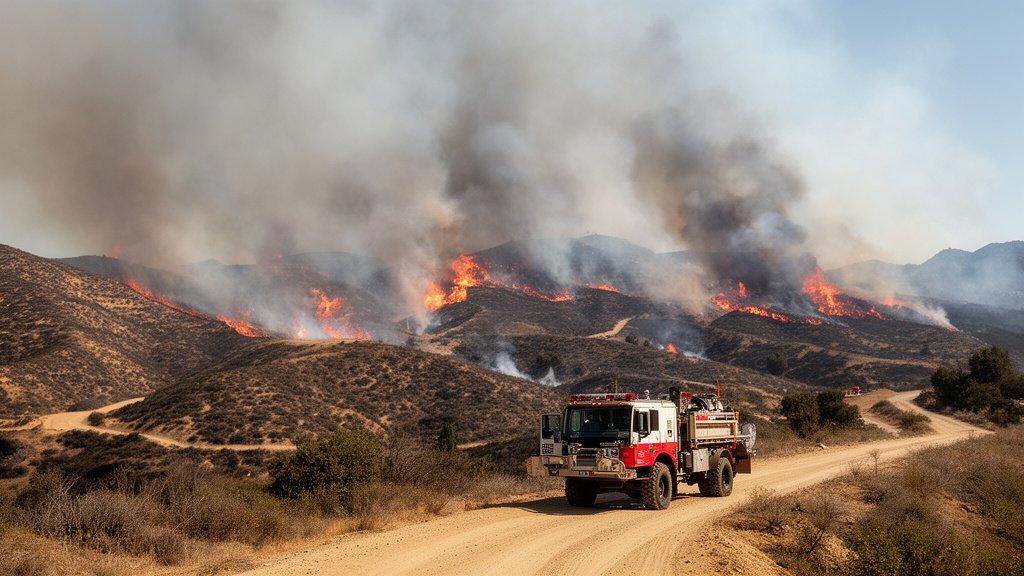
Southern California is currently in the grip of a dangerous weather event as a series of fast-moving brush fires, including the newly ignited Norte fire in Orange County and the persistent Bryson fire in Malibu, have forced mandatory evacuations and critical road closures across the region. With the Santa Ana wind system driving flames into residential areas, emergency services are working at maximum capacity to contain the blaze and protect property as the region braces for an extended period of extreme heat.
Key Highlights
- Multiple Fronts: The Norte fire in Orange County and the Bryson fire in Malibu remain the primary points of concern, with rapid spread due to heavy winds.
- Mandatory Evacuations: Authorities have issued immediate evacuation orders for neighborhoods in the path of the fires, urging residents to follow local mandates strictly.
- Infrastructure Impact: Major road closures are in effect, complicating emergency response routes and local traffic flow.
- Weather Drivers: The region is currently experiencing classic Santa Ana wind conditions, characterized by dry, gusty winds that dramatically increase fire susceptibility.
The Crisis: Analyzing the Norte and Bryson Fire Fronts
The current emergency in Southern California represents a stark reminder of the region’s extreme vulnerability to seasonal weather shifts. The simultaneous eruption of the Norte fire in Orange County and the ongoing battle against the Bryson fire in Malibu has stretched the resources of the Orange County Fire Authority and the Los Angeles County Fire Department to their breaking point. These fires are not merely burning vegetation; they are actively threatening home infrastructure and forcing thousands of residents to leave their livelihoods behind.
The Science of the Santa Ana Winds
The primary driver of this volatility is the Santa Ana wind system. These winds are a local manifestation of a larger atmospheric process where high-pressure systems move over the Great Basin, forcing air down toward the Southern California coast. As the air descends, it compresses and heats up, losing moisture in the process. When this dry, hot air funnels through narrow mountain passes—like the canyons near Malibu and the hills of Orange County—it creates localized wind speeds that can easily exceed 50 to 60 miles per hour.
This phenomenon creates a “perfect storm” for fire behavior. The winds are not only desiccating the local landscape, turning dry brush into highly combustible fuel, but they are also actively transporting burning embers far ahead of the main fire front. This “spotting” effect means that fires can jump firebreaks, roads, and defensible spaces in seconds, making them incredibly difficult for ground crews to contain. The National Weather Service has issued red flag warnings across the region, which remain in effect as the fire fighting operations continue.
Infrastructure, Evacuations, and Strategic Response
The immediate priority for the Orange County Fire Authority and the Los Angeles County Fire Department remains the protection of life. Evacuation orders are not issued lightly, and the speed at which the Norte and Bryson fires are advancing has left little room for error. Major arterial roads have been closed to prioritize the movement of fire engines and heavy equipment, but these closures have also trapped many residents in the immediate vicinity of the smoke and flames.
Strategic defense of residential areas is currently focused on creating “perimeters of denial,” where fire crews use back-burning techniques to remove potential fuel between the fires and homes. However, the intensity of the winds is currently hindering aerial suppression efforts. Fixed-wing aircraft and helicopters, which are essential for dropping fire retardant and water on steep, inaccessible terrain, are often grounded when wind speeds exceed safe operational limits. This reliance on ground-based hand crews and bulldozers creates a precarious situation that evolves minute by minute.
Secondary Angles: A Regional Resilience Perspective
To understand the broader implications of these events, we must look at three critical, often overlooked aspects of the SoCal wildfire crisis:
1. The Economic Ripple Effect on Housing and Insurance: Beyond the immediate loss of homes, these recurring fire events are fundamentally altering the insurance landscape in California. As private insurers increase premiums or withdraw from high-risk zones, the economic burden shifts to homeowners and the state’s FAIR Plan. This creates a hidden, long-term crisis where property values in fire-prone zones become volatile, potentially leading to a broader regional real estate instability.
2. Historical Context of the ‘Fire Season’: Historically, Southern California wildfire seasons were confined to the late autumn and early winter. However, shifting climate patterns have extended the threat window. The current conditions are not an anomaly; they are increasingly part of a new seasonal reality. The overlapping nature of the Norte and Bryson fires highlights how modern fires are no longer isolated incidents but regional events that test the interoperability of agencies across county lines.
3. Technological Advancements in Fire Prediction: Despite the destruction, there is a silver lining in the adoption of AI-driven satellite monitoring and real-time sensor networks by the Cal OES (Office of Emergency Services). These technologies are now providing firefighters with granular data on fire spread and heat signatures, allowing for more precise resource allocation. While the fires are devastating, the speed of notification for residents has improved significantly compared to decades past, directly contributing to the preservation of life.
As the situation unfolds, residents are urged to remain vigilant, monitor local emergency broadcasts, and adhere strictly to evacuation notices. The combination of sustained high temperatures and these unpredictable, high-velocity winds suggests that the danger will persist until the atmospheric conditions stabilize.
FAQ: People Also Ask
Q: What are the primary dangers during Santa Ana wind events?
A: During Santa Ana conditions, the primary dangers are rapid fire spread, extreme ember casting which ignites fires miles ahead of the main line, and the grounding of aerial firefighting resources due to wind turbulence, which leaves ground crews isolated.
Q: Why are evacuations mandatory instead of recommended?
A: Mandatory evacuations are issued when the speed of fire growth is unpredictable. They ensure that first responders can access the area without being hindered by civilian traffic, and they protect residents from being trapped by shifting wind patterns that can surround evacuation routes in minutes.
Q: How can residents track the latest developments for the Norte and Bryson fires?
A: Residents should prioritize official channels, specifically the Twitter/X accounts of the Orange County Fire Authority and the Los Angeles County Fire Department, and check local emergency websites like CalFire’s incident dashboard for real-time maps and shelter locations.
Q: What should be in a ‘Go Bag’ for fire evacuations?
A: A standard ‘Go Bag’ should contain essential documents (IDs, insurance), critical medications, a three-day supply of water, non-perishable food, portable power banks, a battery-powered radio, and personal hygiene items, all ready to grab at a moment’s notice.