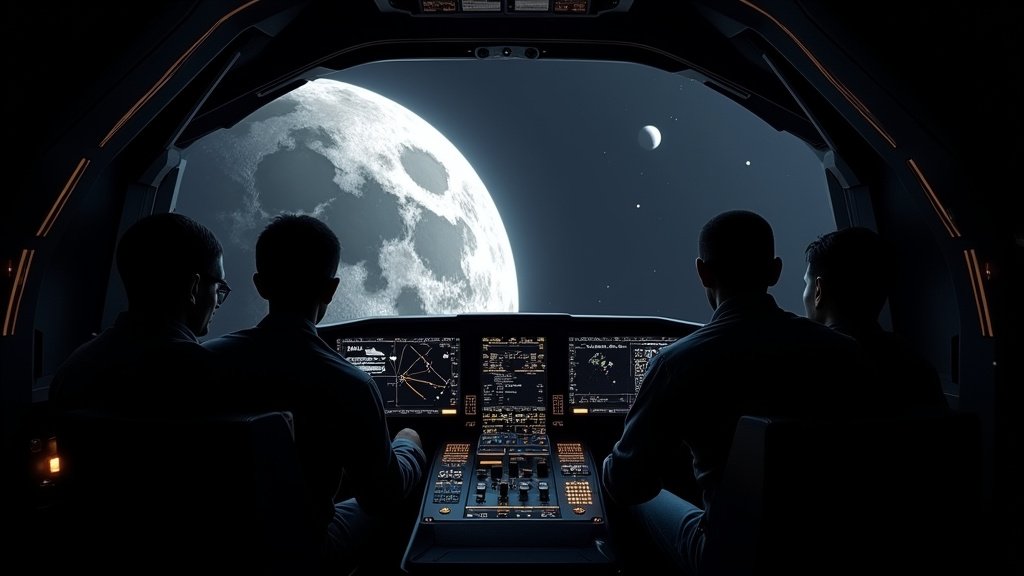
NASA is gearing up for the highly anticipated Artemis II mission, a crucial step in its ambitious plan to return humans to the Moon. This upcoming flight will see astronauts orbit the Moon, testing critical systems and paving the way for future lunar landings. The mission represents a significant milestone in space exploration, building upon the successes of the uncrewed Artemis I mission.
Key Highlights:
- Artemis II will carry a crew of four astronauts on a journey around the Moon.
- The mission will test the Orion spacecraft’s life support systems and human-rated capabilities.
- This flight is a precursor to Artemis III, which aims to land astronauts on the lunar south pole.
- The mission signifies a renewed global interest in lunar exploration and scientific discovery.
Artemis II: A Giant Leap for Lunar Exploration
NASA’s Artemis program, named after the twin sister of Apollo in Greek mythology, aims to establish a sustained human presence on the Moon. Artemis II, scheduled for launch in late 2024, will be the first crewed mission of the program. It will serve as a vital testbed for the technologies and procedures necessary for long-duration space missions beyond Earth orbit.
Mission Objectives and Trajectory
The primary objective of Artemis II is to perform a lunar flyby with a human crew aboard the Orion spacecraft. The four astronauts will travel further into space than any humans have before, reaching a distance of approximately 230,000 miles from Earth. During the approximately 10-day mission, the crew will conduct various tests on the Orion spacecraft, including its advanced life support systems, communication capabilities, and navigation. This flight will allow NASA engineers to validate the spacecraft’s performance under real-world deep-space conditions, ensuring its readiness for more complex missions.
The Orion Spacecraft and SLS Rocket
The Orion spacecraft, designed to carry astronauts on deep-space missions, is a critical component of the Artemis program. It is capable of supporting a crew for up to 21 days and is equipped with state-of-the-art life support, navigation, and communication systems. The spacecraft will be launched by the Space Launch System (SLS), the most powerful rocket ever built by NASA. The SLS rocket is essential for propelling Orion and its crew beyond Earth’s gravitational pull and towards the Moon.
Astronaut Crew Selection and Training
The crew for Artemis II comprises four highly experienced astronauts: Reid Wiseman, Victor Glover, Christina Koch, and Jeremy Hansen. Wiseman will serve as commander, Glover as pilot, and Koch and Hansen as mission specialists. This diverse crew brings a wealth of experience from previous space missions, including NASA’s Space Shuttle program and the International Space Station (ISS). They have undergone extensive training to prepare for the rigors of the Artemis II mission, simulating various mission scenarios and practicing emergency procedures.
Significance for Future Lunar and Martian Missions
Artemis II is more than just a mission to orbit the Moon; it is a foundational step towards NASA’s long-term goals of establishing a lunar base and eventually sending humans to Mars. The data and experience gained from Artemis II will be instrumental in refining the technologies and operational strategies needed for extended lunar stays and interplanetary travel. By mastering operations in deep space, NASA aims to unlock new scientific discoveries, develop new technologies, and inspire the next generation of explorers.
FAQ: People Also Ask
What is the main goal of the Artemis II mission?
The main goal of the Artemis II mission is to send a crew of four astronauts on a lunar flyby, testing the Orion spacecraft’s human-rated systems and preparing for future lunar landings.
Who are the astronauts on the Artemis II mission?
The crew consists of Commander Reid Wiseman, Pilot Victor Glover, and Mission Specialists Christina Koch and Jeremy Hansen.
When is the Artemis II mission expected to launch?
Artemis II is currently scheduled for a late 2024 launch, with the exact date subject to final mission preparations and approvals.
What is the difference between Artemis I and Artemis II?
Artemis I was an uncrewed test flight of the SLS rocket and Orion spacecraft around the Moon. Artemis II will be the first crewed mission of the program, with astronauts orbiting the Moon.
What are the long-term goals of the Artemis program?
The long-term goals of the Artemis program include establishing a sustainable human presence on the Moon and eventually sending astronauts to Mars.