California’s ongoing struggle to balance energy production with water conservation has long created a friction point between the state’s agricultural backbone and its aggressive clean energy mandates. For years, the debate centered on land use: should massive solar farms consume precious agricultural land, or should they remain isolated to the desert? A revolutionary solution has emerged from the Turlock Irrigation District, known as Project Nexus, which effectively side-steps this conflict by utilizing existing infrastructure. By hovering solar panels over irrigation canals, the state is discovering a multi-benefit approach that generates renewable power while shielding vital water resources from the punishing California sun.
Key Highlights
- Dual-Purpose Infrastructure: Project Nexus, a 1.6-megawatt pilot, installs solar panels directly over irrigation canals, maximizing land-use efficiency.
- Water Conservation: By providing shade to the canals, the system significantly reduces evaporation rates, saving thousands of gallons of water annually—a critical resource during periods of drought.
- Energy Generation: The arrays provide clean electricity to the local grid, helping the state meet its 100% clean energy goals without displacing farmland.
- Co-Benefits: The system also reduces aquatic weed growth and lowers water temperatures, which can improve water quality for downstream agricultural use.
- Scalable Potential: With over 4,000 miles of irrigation canals in California, the success of this pilot paves the way for state-wide expansion that could generate gigawatts of power.
The Engineering of the Nexus: A New Frontier in Infrastructure
The implementation of Project Nexus represents a paradigm shift in how we conceive of ‘land use’ for renewable energy. Historically, the expansion of solar in California’s Central Valley was met with fierce resistance from agricultural stakeholders who feared that acres of valuable cropland would be permanently lost to energy development. Project Nexus, however, changes the calculus entirely by leveraging the 4,000 miles of existing irrigation canals that crisscross the state.
From Research to Reality
This initiative did not spring up overnight. It began with rigorous academic inquiry led by researchers at UC Merced. Their study, published in Nature Sustainability, hypothesized that if California covered its entire canal network with solar panels, the potential benefits would be monumental. The study suggested that covering these canals could prevent the evaporation of up to 63 billion gallons of water annually, equivalent to the water usage of millions of residents. The pilot program, which transformed these academic theories into tangible steel and silicon, was developed through a strategic partnership between the Turlock Irrigation District (TID), the startup Solar AquaGrid, and the California Department of Water Resources. The infrastructure is not merely a cover; it is a precisely engineered system designed to withstand the unique environmental challenges of an open-air canal environment.
Overcoming the Elements
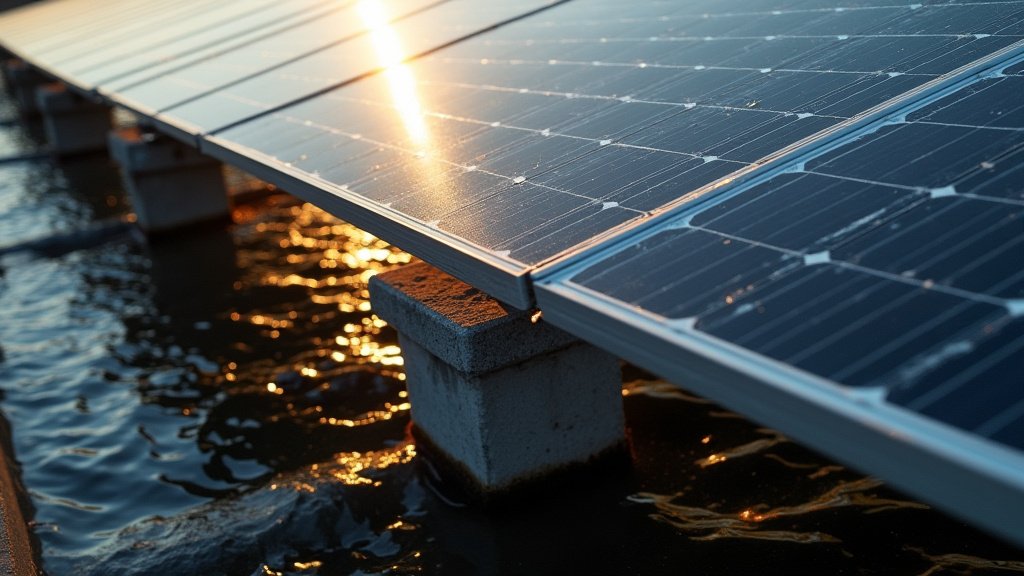
Constructing solar arrays over water presents unique engineering challenges compared to ground-mounted systems. Designers had to account for high humidity, the structural stability of canal embankments, and the requirement for maintenance crews to access the water below. The solution involved specialized, elevated support structures that allow for easy cleaning and maintenance. Furthermore, the microclimate created under the panels—which are cooler due to the water below—can actually improve the efficiency of the photovoltaic cells, which generally operate better at lower temperatures than they do in the scorching heat of a traditional land-based solar farm.
The Economic and Environmental Synergy
The ‘Nexus’ in the project’s name refers to the intersection of energy and water, two pillars of the California economy that are frequently at odds. By co-locating these systems, the project addresses the state’s ‘Land-Energy-Water’ trilemma.
Agricultural Resilience
For the agricultural sector, the benefits are not merely abstract. In the Central Valley, water is currency. Any method that reduces loss via evaporation provides an immediate, tangible benefit to irrigation districts and farmers who rely on that water for crop yields. Moreover, by shading the canal, the solar panels reduce the sunlight available to fuel the growth of invasive aquatic weeds, which can clog intake valves and slow the flow of water. This reduction in biological growth reduces the maintenance costs associated with dredging and clearing the canals.
Addressing the Energy Grid
From an energy perspective, the project provides decentralized power. By generating electricity closer to where it is needed—often in rural or semi-rural areas that have historically faced challenges with power stability—the project reduces the reliance on long-distance transmission lines, which are themselves a fire risk and a source of energy loss. As California pushes toward its ambitious 2045 deadline for 100% clean energy, these localized, dual-purpose projects provide a vital piece of the puzzle that does not rely on massive, contentious land acquisitions.
Future Implications and Global Scalability
While Project Nexus is currently a pilot, the implications are global. Water scarcity is a challenge facing arid regions worldwide, from the American Southwest to the Middle East and parts of India. The success of this California project proves that we do not always need to choose between environmental conservation and energy production. We can, with the right engineering, achieve both.
The Road to Expansion
Moving forward, the primary hurdle for large-scale adoption is the initial capital expenditure. Spanning a canal is more expensive than laying panels on flat, empty ground. However, when the ‘cost’ of the project is adjusted to include the value of the saved water and the reduced environmental impact, the return on investment becomes far more compelling. Policymakers are now looking at how to integrate this technology into future infrastructure bills, potentially incentivizing irrigation districts to partner with private developers to ‘cap’ their canals with solar arrays. If the state manages to roll this out across its vast canal network, it will secure its place as a leader in innovative, resilient climate infrastructure.
FAQ: People Also Ask
Does covering the canals harm the water quality or ecosystem?
Actually, it has potential benefits. By reducing sunlight exposure, the panels suppress the growth of aquatic weeds and algae, which can sometimes degrade water quality and clog infrastructure. While local environmental impact studies are ongoing, preliminary data suggests the benefits to water management outweigh the ecological disruption.
Is this technology expensive compared to traditional solar farms?
Yes, the upfront capital costs are higher because the structural support systems required to span a canal are more complex than those used for ground-mounted arrays. However, the ‘value proposition’ changes when you factor in water savings and the preservation of agricultural land, which is a major economic asset in California.
Why haven’t we done this on all canals yet?
Scaling requires complex coordination between irrigation districts, water rights holders, and energy regulators. Not every canal is suitable for solar coverage due to maintenance access needs, varying canal widths, and local geography. However, the pilot project has provided a ‘playbook’ for how to overcome these logistical hurdles in future deployments.
Does the water cooling effect really help the solar panels?
Yes. Photovoltaic efficiency generally decreases as panel temperature increases. The cooling effect of the water evaporating beneath the panels helps keep them cooler than they would be in an open field, which can marginally increase their operational efficiency during the hottest parts of the day.