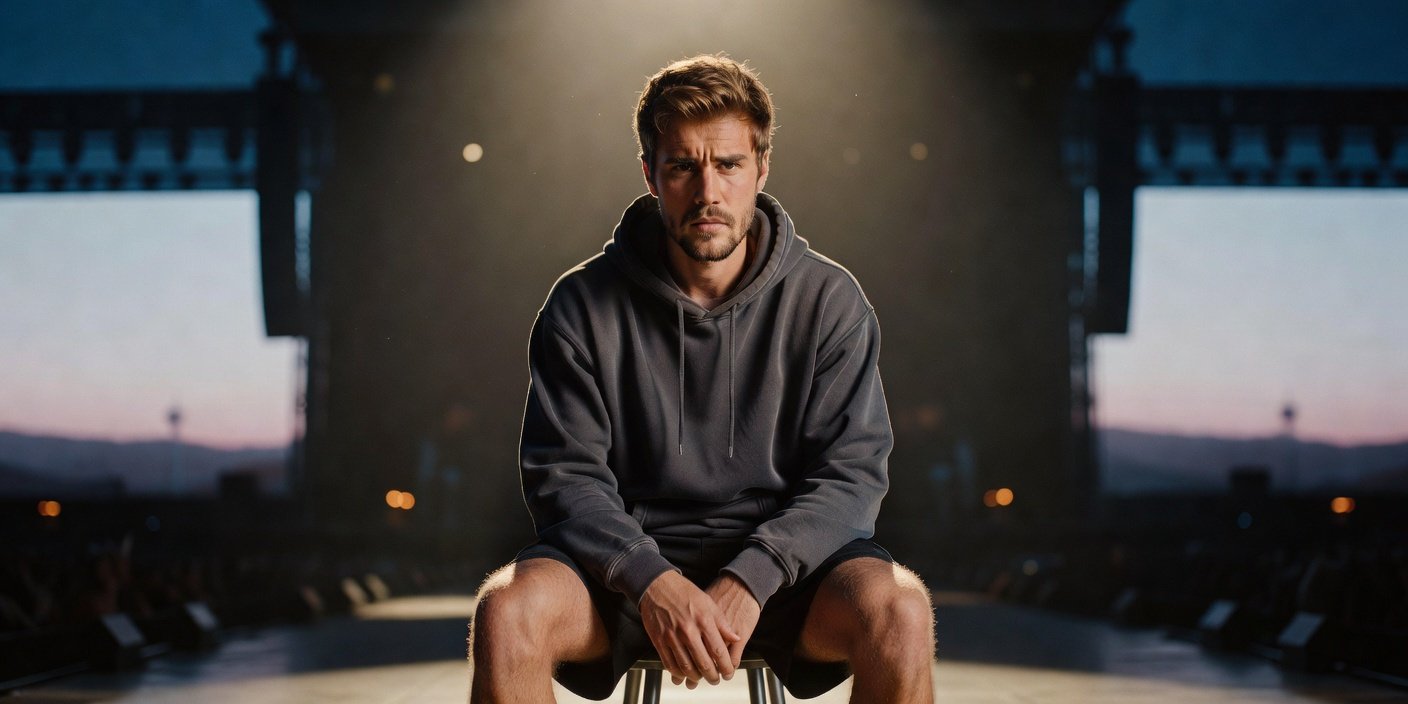
Justin Bieber’s highly anticipated return to the desert stage at Coachella 2026 has resulted in a polarizing cultural moment, with thousands of fans and critics slamming the global superstar for what many described as a ‘lazy,’ low-effort performance. Despite commanding a record-breaking reported $10 million fee for the headline slot, Bieber’s set—which relied on a laptop, a stool, and a collection of viral YouTube videos from his adolescence—has left the music industry debating the shifting expectations of live performance and the massive economic gap between fan experience and artist compensation.
Key Highlights
- The ‘Laptop’ Performance: Bieber’s 90-minute set departed from traditional, high-production festival spectacles, instead opting for a minimalist, nostalgic approach where he sat on a stool and curated a live stream of his own career’s music videos.
- $10 Million Controversy: The reported eight-figure paycheck for a set that lacked complex choreography or elaborate staging has sparked outrage, with critics calling it a ‘scam’ compared to the high-energy production of other headliners.
- The Double Standard Debate: Social media discourse has exploded over perceived gender biases, with fans comparing Bieber’s ‘casual’ reception to the rigorous, high-octane production standards typically expected of female artists like Sabrina Carpenter.
- Artistic Intent vs. Consumer Expectation: While detractors labeled the set as ‘lazy,’ some industry analysts and fans are framing the show as a meta-commentary on Bieber’s origin story, challenging the performative nature of modern celebrity.
The Anatomy of the ‘Bieberchella’ Backlash
The fundamental tension at Coachella 2026 centers on the evolving contract between headlining artists and their audiences. In an era where festival-goers spend thousands of dollars on tickets, travel, and lodging, expectations for a headliner—particularly one receiving a paycheck as large as Bieber’s—are astronomical. The standard has historically been set by massive, choreographed spectacles from icons like Beyoncé or Lady Gaga. When Justin Bieber walked onto the main stage wearing a simple hoodie and shorts, bypassing traditional dance routines in favor of scrolling through his own YouTube history on a MacBook, he wasn’t just performing; he was disrupting the established visual language of the festival experience.
The Economics of the $10 Million Gig
Financial transparency in the music industry is notoriously murky, but the circulating figure of $10 million for Bieber’s performance has become a lightning rod for criticism. When the math is applied to a set perceived as ‘low-effort,’ the public backlash becomes visceral. Fans on X (formerly Twitter) and TikTok have been ruthless in their breakdown of the cost-per-minute of entertainment, with viral posts questioning why a headliner would accept such a premium fee while delivering a set that arguably required less logistical preparation than those of his peers. This discussion touches on a larger economic truth: the value of a ‘name’ often outweighs the technical output of the performance itself, creating a disconnect that festival organizers are now struggling to manage.
Gender Dynamics and Performance Expectations
Perhaps the most compelling secondary angle to this controversy is the comparison to fellow performer Sabrina Carpenter. Throughout the weekend, discourse consistently pivoted to the ‘double standards’ of the music industry. Many fans noted that a female pop star performing in a hoodie, sitting on a stool, and playing YouTube videos would likely face career-ending criticism, whereas Bieber’s ‘authenticity’ and ‘laid-back’ aura are often coded as artistic choices rather than unprofessionalism. This discourse highlights a lingering, systemic imbalance in how audiences and critics judge male vs. female performance quality, fueling a necessary conversation about the rigid ‘perfection’ standards imposed on female artists.
Deconstruction or Disengagement?
To understand the backlash, one must look at what Bieber was actually trying to achieve. By projecting his early YouTube videos—the very platform that launched his career—Bieber was arguably attempting to bridge the gap between the teenage viral sensation he once was and the mature artist he is today. However, the nuance was lost on a massive, festival-sized crowd that had likely paid to see a ‘show,’ not a semi-ironic retrospective. The moment the Wi-Fi at the festival allegedly buffered, forcing the star to lament the technical issues, the ‘artistic’ deconstruction began to look like a lack of preparation, turning a potential meta-moment into a PR challenge.
FAQ: People Also Ask
Q: Was Justin Bieber’s Coachella performance actually just him playing YouTube videos?
A: While not the entire show, a significant portion of his set involved him sitting on a stool and interacting with a laptop, broadcasting clips from his early career. He interspersed these with live music and guest appearances, but the laptop segments were the primary source of the ‘lazy’ criticism.
Q: Why are people comparing his set to Sabrina Carpenter’s?
A: Sabrina Carpenter performed at the same festival and delivered a set with heavy production, choreography, and high energy. Fans used her performance as a benchmark to highlight that male artists are often granted more leniency for low-production sets, while female artists are expected to deliver ‘perfect’ shows to maintain their status.
Q: Did Bieber address the backlash?
A: As of now, Bieber has not released a formal statement regarding the specific ‘lazy’ allegations. However, supporters argue his performance was a reflection of his ‘Swag’ era, focusing on personal connection rather than spectacle.
Q: What is the significance of the $10 million fee?
A: The $10 million report is the catalyst for the outrage. It created a perception that the festival ‘overpaid’ for a performer who provided a minimal effort set, leading fans to express feelings of being cheated by the value proposition of the concert experience.