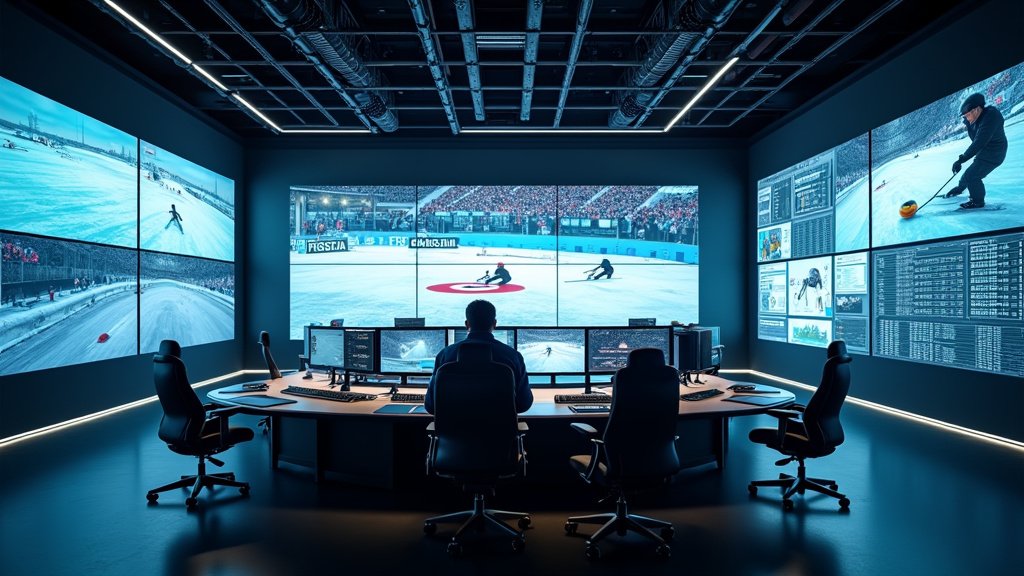
2026 Winter Olympics Embrace AI Broadcast Innovations
The 2026 Winter Olympics in Milan and Cortina will showcase significant AI broadcast innovations. These advancements, recently revealed by organizers, aim to enhance the viewer experience through integrated AI. This evolution promises a more immersive and dynamic broadcast powered by cutting-edge AI broadcast innovations.
AI-Powered Replays: A Key AI Broadcast Innovation
A central AI broadcast innovation is AI-supported real-time 360-degree replays. This sophisticated system, which debuted at the Paris 2024 Olympics, synthesizes multiple camera feeds. Stroboscopic analysis enables detailed multi-angle views, with freeze frames and slow-motion sequences generated in mere seconds. Olympic Broadcasting Services (OBS) CEO Yiannis Exarchos elaborated on this during an online media roundtable, noting that the system was developed in collaboration with OBS by Alibaba. This technology fosters a profound sense of immersion, allowing viewers to meticulously analyze athlete movements, a core aspect of the enhanced fan experience. The AI replays will cover 21 sports across 14 venues, creating a “bullet time” effect that lets viewers explore athlete actions in unprecedented detail.
Enhanced Sports-Specific AI Features
Curling will feature an AI-driven stone-tracking system, a first for the Winter Olympics, demonstrating exciting AI sports features. This system visualizes each stone’s trajectory, displaying real-time speed and rotation data overlaid with graphics that explain strategic nuances. Exarchos aptly described curling as “chess on ice,” and AI is set to significantly help viewers grasp this complexity. Furthermore, First Person View drones will capture thrilling footage in sliding sports like bobsleigh and luge, offering a sense of direct participation in the competition through these innovative AI broadcast innovations.
Streamlining Content and Information with AI
An Automatic Media Description platform is undergoing testing to manage the vast quantities of live video. This AI content generation tool breaks down broadcasts into searchable clips, suggesting shot descriptions and keywords to accelerate content discovery and storytelling. Automated highlights generation, which produced over 100,000 clips for Paris 2024, will also see its first application at a Winter Games, ensuring viewers can efficiently catch up on trending moments through these AI broadcast innovations.
AI for Fan Engagement and Enhanced Fan Experience
An AI tool named Olympic GPT will be launched, providing fans with instant information, including real-time results, rules, and verified facts, to foster an enhanced fan experience. NBCUniversal is also bringing back OLI, its AI-powered guide, now with expanded features to help fans navigate thousands of hours of coverage and answer questions about viewing schedules. Utilizing Google Cloud’s Gemini LLM, OLI simplifies the viewer experience, ensuring fans can enjoy all the action without missing key events thanks to these Olympic AI tools.
Technological Advancements and Cloud Broadcasting Efficiency
The Games will leverage OBS Cloud 3.0, operating on Alibaba Cloud infrastructure, marking a significant shift towards cloud broadcasting as the primary distribution method, a first for the Olympics. This approach replaces traditional satellite transmission. Virtual OB Van technology allows for remote control of broadcasts from studios, eliminating the need for on-site trucks, reducing compound space, and cutting power usage. These efficiencies driven by AI broadcast innovations are projected to reduce costs by up to 50 percent.
The Future of Sports Broadcasting Fueled by AI Broadcast Innovations
AI is fundamentally transforming sports broadcasting, offering deeper insights and creating more personalized content to enhance the enhanced fan experience. Automation and AI provide practical solutions, making sports coverage more accessible and creative. The trend points towards data-driven storytelling and personalized highlights becoming standard. While AI handles repetitive tasks, human creativity remains indispensable, with the best broadcasts balancing AI efficiency with a human touch. The 2026 Winter Olympics will serve as a crucial showcase for these transformative AI broadcast innovations, offering a glimpse into the future of sports entertainment and the sports broadcasting future.