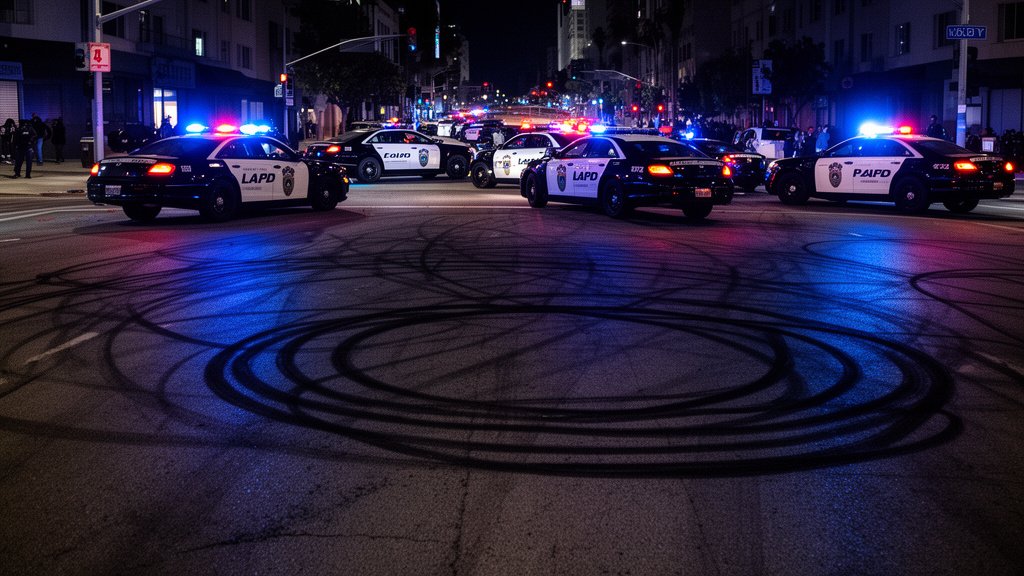
The Los Angeles Police Department has executed a significant enforcement action against the escalating issue of illegal street takeovers, resulting in the successful arrest of 69 individuals and the stabilization of a high-risk scene. This operation marks a pivotal moment in the ongoing battle between local authorities and the organizers of these unauthorized exhibitions, which have increasingly plagued the metropolitan landscape with reckless driving, property damage, and severe public safety risks. The targeted intervention by law enforcement highlights a shift in operational strategy, moving from reactive monitoring to proactive, mass-detention tactics designed to deter future participation.
Key Highlights
- Total Enforcement: 69 individuals were taken into custody during the coordinated operation.
- Strategic Shift: The enforcement reflects the LAPD’s renewed commitment to utilizing the Street Racing Task Force (SRTF) to actively disrupt and dismantle large-scale takeover events.
- Public Safety Focus: The crackdown aims to curb the increasing frequency of “sideshows” and illegal street racing that result in vehicle impoundments and civilian injuries.
- Zero Tolerance: Local authorities have signaled that further operations are planned to hold both participants and organizers accountable under California state laws.
Combatting the Rise of the ‘Sideshow’ Culture
The phenomenon of the illegal street takeover, often colloquially referred to as a “sideshow,” has evolved into a sophisticated, digitally coordinated nuisance that stretches the resources of the LAPD to their breaking point. These events are characterized by groups of drivers taking control of public intersections or parking lots to perform donuts, burnouts, and other dangerous vehicular stunts, often while surrounded by large crowds of spectators. The recent arrest of 69 individuals serves as a stark reminder of the legal consequences awaiting those who participate in these volatile gatherings.
The Operational Blueprint
Law enforcement agencies, particularly the Street Racing Task Force (SRTF), have had to adapt to the speed at which these groups coordinate via social media platforms. The most recent operation utilized aerial support, ground-level containment, and rapid response units to effectively box in participants before they could scatter. By targeting the entire group simultaneously, the LAPD is attempting to break the “strength in numbers” mentality that has historically emboldened takeover participants. This strategy involves not only arresting those behind the wheel but also processing spectators and accomplices who facilitate the chaos.
Socio-Technical Drivers of Takeovers
Understanding the persistence of street takeovers requires looking at the role of social media. Platforms like Instagram and TikTok have turned illegal racing into a viral commodity, where “clout” is measured by the number of views a video of a dangerous drift receives. This digital validation loop creates a dangerous incentive for participants to push the limits of their vehicles in public spaces. The LAPD’s recent crackdown is not merely about traffic enforcement; it is a direct challenge to the digital infrastructure that enables these flash-mob style events to proliferate.
Legal and Economic Consequences
Beyond the immediate criminal charges of reckless driving and participation in an illegal exhibition of speed, the financial ramifications for participants are severe. California Vehicle Code sections governing these activities often result in immediate vehicle impoundment. The costs associated with storage fees, fines, and potential license suspensions serve as a long-term economic deterrent. Furthermore, the city of Los Angeles faces ongoing expenses related to road surface repair, as burnouts and collisions significantly degrade asphalt, requiring taxpayer-funded infrastructure maintenance.
Future Outlook: A Deterrence Strategy
The 69 arrests are viewed by community advocates and local officials as a necessary step toward restoring order. However, the question remains whether these tactical interventions can provide a lasting solution. Experts suggest that a multi-pronged approach—combining aggressive enforcement with legislative pushes for increased penalties and community outreach programs—is essential. As the LAPD continues to refine its tactics, the goal remains clear: to reclaim public thoroughfares and ensure that the “sideshow” culture does not become an accepted norm in urban centers.
FAQ: People Also Ask
Q: What is the main charge against those arrested at street takeovers?
A: While specific charges can vary, participants are typically booked for “Exhibition of Speed,” “Reckless Driving,” and in some instances, “Aiding and Abetting” or conspiracy, depending on their role in organizing or filming the event.
Q: How does the LAPD identify takeover events before they happen?
A: The LAPD’s Street Racing Task Force monitors social media and digital intelligence to anticipate where these flash-mob events may occur. They also rely on a network of traffic cameras and civilian tips to track the movement of large groups of performance vehicles.
Q: Are spectators at these events also arrested?
A: Yes. Law enforcement has increasingly targeted spectators, as their presence is what drives the event’s popularity. Depending on the circumstances and local ordinances, spectators may be cited or arrested for “being present at an illegal street race” or public nuisance charges.
Q: What happens to the vehicles seized during these operations?
A: Seized vehicles are typically impounded. Owners must pay significant fees to retrieve them, and in cases of repeat offenses or where the vehicle was involved in criminal activity, the cars may be subject to longer-term forfeiture procedures.