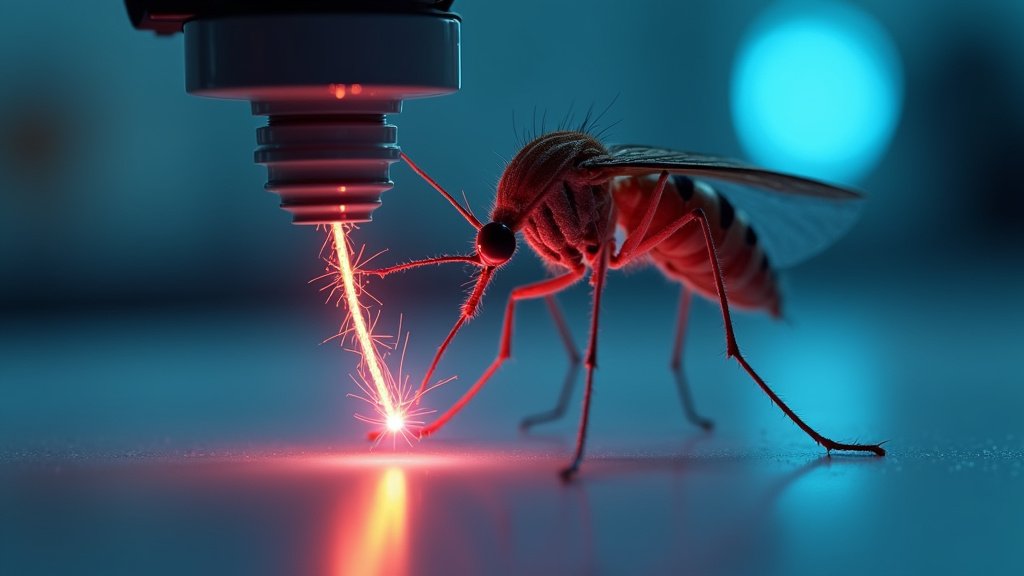
Nature offers incredible engineering solutions. Researchers have found a new one in mosquitoes. Their needle-like mouths can print lines thinner than a human hair. This breakthrough is called “3D necroprinting”. It uses repurposed mosquito proboscises as tiny nozzles.
Nature’s Precision Tool
The female mosquito’s proboscis is a marvel. It’s evolved for precise skin penetration. This natural structure is also remarkably stiff and straight. It’s hollow with a very narrow inner diameter, typically 10 to 20 micrometers. These traits make it perfect for fine 3D printing. It can withstand significant pressure.
Introducing 3D Necroprinting
Engineer Changhong Cao led this research. He works at McGill University. His team collaborated with Drexel University. They call the technique “3D necroprinting”. The name comes from necrobotics. This field uses animal parts in machines. Instead of mimicking nature, they use actual biological parts. A dead mosquito’s proboscis becomes the printer’s nozzle.
Achieving Unprecedented Detail
Traditional 3D printing nozzles can be expensive. They also have limitations in resolution. Commercial tips often measure 35 to 40 micrometers wide. The mosquito proboscis nozzle can print lines as fine as 20 micrometers. This is about half the width of a human hair. It’s even finer than most cutting-edge commercial nozzles. This allows for printing incredibly intricate structures.
Benefits Beyond Precision
This innovation offers significant advantages. It greatly reduces costs. Expensive metal or glass nozzles can cost around $80. A mosquito proboscis is much cheaper. It’s also sustainable. The biological nozzles are biodegradable. This repurposes materials that might otherwise be discarded. It also helps make advanced 3D printing more accessible.
Exploring Future Applications
The potential applications for 3D necroprinting are vast. Scientists can explore new frontiers in biomedical engineering. The ultra-fine printing is ideal for creating tiny scaffolds for cell growth. It can also print delicate cell-laden gels. Furthermore, the technique shows promise for transferring microscopic objects. Examples include semiconductor chips. Researchers are also looking into high-resolution drug delivery systems. This news is exciting and represents a trending development.
A Sustainable Future
This research paves the way for new advances. It shows how nature’s designs can solve engineering challenges. The team tested various animal parts. They chose the mosquito proboscis for its unique properties. The process involves preparing the proboscis from deceased mosquitoes. It is then attached to a printer. This method offers a low-cost, environmentally friendly alternative. We can enjoy exploring these natural solutions. The future of micro-manufacturing looks promising. This news continues to generate buzz.
This groundbreaking work was published in Science Advances. It highlights nature’s ingenuity. It also offers a sustainable path forward for manufacturing.